History Zagreb: What Every Hotel Dubrovnik Guest Should Discover
The history Zagreb tells is one of resilience, rivalry, and remarkable transformation. If you're staying at Hotel Dubrovnik, you're literally standing at the epicentre of centuries of Croatian heritage, right on Ban Jelačić Square.
And honestly? That's not just convenient. It's the perfect launchpad to understand why this city became what it is today.
Let me walk you through the story that shaped the streets you'll wander, the buildings you'll photograph, and the culture you'll experience.
Medieval Origins: The Twin Settlements
Here's where it gets interesting. Zagreb didn't start as one city. It began as two separate, fiercely competitive settlements perched on neighbouring hills. Think of it like having two rival siblings forced to share the same neighbourhood.
Kaptol and Gradec (1094-1242)
In 1094, Hungarian King Ladislaus I established Kaptol as an ecclesiastical powerhouse. This wasn't just a church on a hill. It was the religious and administrative heart of the region, complete with bishops, canons, and all the ecclesiastical authority you could imagine.
Fast forward to 1242, and King Bela IV issued the Golden Bull, granting Gradec the status of a free royal town. This gave Gradec autonomy, trade privileges, and a big chip on its shoulder. The history Zagreb experienced over the next few centuries was defined by this rivalry.
Between these two hills ran the Medveščak creek (today's Tkalčićeva Street). This wasn't just a geographical divide. It was a battleground. Disputes over taxes, jurisdiction, and economic control led to actual conflicts, with residents from both sides occasionally setting fire to each other's properties.
The tension lasted for centuries until 1850, when someone finally said, "Enough of this nonsense," and merged them into a single city.
Upper Town Landmarks
The Upper Town (Gornji Grad) is where the history Zagreb preserved comes alive in every cobblestone and cathedral spire. Two landmarks stand out, and both are minutes from Hotel Dubrovnik.
St. Mark's Church
You can't miss St. Mark's Church. The roof alone makes it one of the most photographed buildings in Croatia. Those colourful tiles aren't just decorative. They display the coat of arms of Zagreb on the left and the historic Kingdom of Croatia, Slavonia, and Dalmatia on the right.
The church itself blends Gothic and Romanesque styles, built and rebuilt over centuries. It's been standing since the 13th century, witnessing every major event in Croatian history from this elevated perch.
Walk through the Stone Gate nearby. It's the last remaining entrance from Zagreb's medieval fortifications, and locals still light candles in the small chapel inside.
Zagreb Cathedral
The Zagreb Cathedral dominates the skyline with its twin neo-Gothic spires reaching 108 metres high. Construction began in the 13th century, but the building you see today owes much to reconstruction after the devastating 1880 earthquake.
That earthquake levelled much of old Zagreb. The cathedral was rebuilt in the neo-Gothic style popular at the time, finally completed in 1906. The history Zagreb Cathedral represents isn't just architectural. It's a testament to the city's ability to rebuild and reimagine itself after catastrophe.
The cathedral's interior houses priceless religious art, medieval frescoes, and the tomb of Cardinal Alojzije Stepinac, a controversial but significant figure in 20th-century Croatian Catholicism.
19th Century Transformation
The 1800s changed everything. This is when Zagreb stopped being two rival towns and became a proper European city.
Unification and Croatian National Revival
In 1850, the merger happened. Kaptol and Gradec, along with surrounding settlements, officially became one city. Janko Kamauf became Zagreb's first mayor, tasked with creating unity from centuries of division.
This period coincided with the Croatian National Revival, a cultural and political awakening across Croatian lands. Zagreb became the intellectual centre of this movement. Writers, artists, and politicians gathered here to preserve Croatian language and culture under Austro-Hungarian rule.
The Habsburg influence on architecture is unmistakable. Walk through the Lower Town (Donji Grad) and you'll see the ordered, elegant buildings typical of Vienna or Budapest. This wasn't accidental. Zagreb was part of the empire, and the architecture reflected that connection.
Infrastructure Development
The late 1800s brought rapid modernisation. In 1862, the first railway line connected Zagreb to other regional centres, opening trade and travel. The waterworks arrived in 1878, bringing running water to a growing population.
By 1891, horse-drawn trams clattered through the streets. The Lower Town expanded southward with grand squares, tree-lined boulevards, and the famous "Green Horseshoe" of interconnected parks. The history Zagreb built during this era created the city's elegant bones.
The 1880 earthquake, despite its destruction, forced Zagreb to rebuild with modern standards. Buildings went up with better materials and earthquake-resistant techniques (though, as we'll see, not resistant enough).
20th Century to Present
The 1900s tested Zagreb repeatedly. Wars, regime changes, and natural disasters all left their mark.
World Wars and Independence
During World War II, Zagreb became the capital of the Independent State of Croatia, a Nazi puppet state. This dark period brought occupation, resistance movements, and significant suffering. After liberation in 1945, Zagreb became part of socialist Yugoslavia.
Under Tito's Yugoslavia, Zagreb served as the capital of the Socialist Republic of Croatia. The city modernised with socialist-era housing blocks, industrial development, and cultural institutions. Love it or hate it, this period shaped modern Zagreb's infrastructure.
Everything changed in 1991. Croatia declared independence from Yugoslavia, and Zagreb became the capital of a sovereign nation. The Croatian War of Independence brought challenges, including rocket attacks on the city in 1995, but Zagreb emerged as the political and cultural heart of the new Croatia.
2020 Earthquake and Reconstruction
On March 22, 2020, a 5.4 magnitude earthquake struck Zagreb at 6:24 a.m. It was the strongest quake to hit the city since 1880, and the timing couldn't have been worse. Croatia was in COVID-19 lockdown, complicating emergency response and evacuation efforts.
The earthquake damaged over 26,000 buildings, with the historic downtown bearing the brunt. The Zagreb Cathedral lost one of its spires. Heritage buildings cracked and crumbled. Cultural monuments that had stood for centuries suddenly needed urgent intervention.
The reconstruction costs are staggering. Current estimates exceed €11.5 billion. The EU Solidarity Fund provided over €680 million, and work continues today. Walking through certain areas, you'll still see scaffolding, support structures, and restoration projects in progress.
But here's what matters: the history Zagreb preserves through this reconstruction honours both authenticity and safety. Teams are working to restore buildings using original techniques while incorporating modern earthquake-resistant technology.
Essential Historic Sites Near Hotel Dubrovnik
 Your location couldn't be better for exploring these layers of history. Let me break down what's within easy reach.
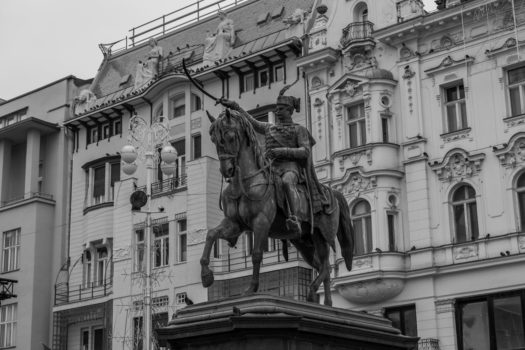
Ban Jelačić Square sits right outside your door. Named after Josip Jelačić, a 19th-century Croatian ban (viceroy), this square has been Zagreb's central meeting point for generations. The equestrian statue in the centre was originally erected in 1866, removed by communist authorities in 1947, and restored to the square in 1990 facing south.
The Upper Town is a seven-minute walk uphill. You can take the funicular (one of the world's shortest and steepest) or walk up through the streets. Once there, you're in medieval Zagreb. St. Mark's Church, Lotrščak Tower (which fires a cannon every day at noon), and the Stone Gate are all clustered together.
Tkalčićeva Street runs where that medieval creek once divided Kaptol and Gradec. Today it's a pedestrian zone packed with cafes, bars, and restaurants in colourful old buildings. It's touristy, sure, but it's also genuinely charming and historically significant.
Museums showcasing Zagreb's past are everywhere. The Zagreb City Museum sits in a former convent and traces the city from prehistoric settlements to the present. The Croatian History Museum occupies a 1920s pavilion designed by Ivan Meštrović. The Museum of Broken Relationships (quirky but beloved) examines personal histories through donated objects from failed relationships.
Every one of these sites connects to the broader narrative. The history Zagreb offers isn't locked away in dusty archives. It's visible, walkable, and waiting just outside.
While historic buildings define the old town, modern shopping centers have emerged in newer districts, showing Zagreb's evolution.
Your location couldn't be better for exploring these layers of history. Let me break down what's within easy reach.
Ban Jelačić Square sits right outside your door. Named after Josip Jelačić, a 19th-century Croatian ban (viceroy), this square has been Zagreb's central meeting point for generations. The equestrian statue in the centre was originally erected in 1866, removed by communist authorities in 1947, and restored to the square in 1990 facing south.
The Upper Town is a seven-minute walk uphill. You can take the funicular (one of the world's shortest and steepest) or walk up through the streets. Once there, you're in medieval Zagreb. St. Mark's Church, Lotrščak Tower (which fires a cannon every day at noon), and the Stone Gate are all clustered together.
Tkalčićeva Street runs where that medieval creek once divided Kaptol and Gradec. Today it's a pedestrian zone packed with cafes, bars, and restaurants in colourful old buildings. It's touristy, sure, but it's also genuinely charming and historically significant.
Museums showcasing Zagreb's past are everywhere. The Zagreb City Museum sits in a former convent and traces the city from prehistoric settlements to the present. The Croatian History Museum occupies a 1920s pavilion designed by Ivan Meštrović. The Museum of Broken Relationships (quirky but beloved) examines personal histories through donated objects from failed relationships.
Every one of these sites connects to the broader narrative. The history Zagreb offers isn't locked away in dusty archives. It's visible, walkable, and waiting just outside.
While historic buildings define the old town, modern shopping centers have emerged in newer districts, showing Zagreb's evolution.
Conclusion
From feuding medieval settlements to a unified European capital, Zagreb's journey mirrors the resilience and complexity of Croatia itself. The layers of history here run deep, from Gothic churches to Habsburg boulevards to earthquake-scarred heritage sites being carefully restored.
Staying at Hotel Dubrovnik puts you at the absolute centre of this story. You're not just close to the history. You're inside it. Ban Jelačić Square has been Zagreb's beating heart for over a century, and your hotel occupies prime real estate for anyone wanting to truly understand this city.
So take that seven-minute walk to the Upper Town. Stand in front of St. Mark's Church. Climb to the cathedral. Wander Tkalčićeva Street at sunset. The history Zagreb holds isn't just something to read about. It's something to experience, and you're positioned perfectly to do exactly that.
Frequently Asked Questions (FAQs)
1. When was Zagreb founded?
Zagreb's history officially begins in 1094 when King Ladislaus I established the Zagreb diocese at Kaptol. However, the name "Zagreb" as a unified city wasn't used until 1850, when the rival settlements of Kaptol and Gradec finally merged under Zagreb's first mayor, Janko Kamauf.
2. What caused the divide between Kaptol and Gradec?
The division stemmed from their different origins and jurisdictions. Kaptol was an ecclesiastical centre under church authority, while Gradec was a free royal town answering directly to the Hungarian king.
This led to disputes over taxes, trade rights, and territorial control that occasionally erupted into actual violence between the two settlements.
3. How did the 2020 earthquake affect Zagreb's historic buildings?
The March 22, 2020 earthquake damaged over 26,000 buildings in Zagreb, with the historic downtown particularly affected. The Zagreb Cathedral lost part of its spire, and numerous heritage buildings in the Upper Town suffered structural damage.
Reconstruction efforts, supported by over €680 million from the EU Solidarity Fund, are still ongoing as of 2025.
4. What is the significance of Ban Jelačić Square?
Ban Jelačić Square has served as Zagreb's main square and central meeting point since the 19th century. Named after Josip Jelačić, a Croatian viceroy who fought for Croatian rights within the Habsburg Empire, the square symbolises Croatian identity and resilience.
The equestrian statue was erected in 1866, removed by communist authorities in 1947, and ceremonially returned in 1990 as Croatia moved toward independence.
5. How long does it take to walk from Hotel Dubrovnik to the Upper Town?
The Upper Town (Gornji Grad) is approximately a seven-minute walk from Hotel Dubrovnik on Ban Jelačić Square. You can walk up through the streets or take the historic funicular railway, which has been operating since 1890 and remains one of the shortest and steepest funiculars in the world.